Podcast Marketing in 2026: How to Promote a Podcast and Actually Grow It
Key points
- Podcast marketing is the practice of growing a show's audience through directory optimisation, social distribution, SEO, cross-promotion with other podcasters, and earned media coverage.
- The job is not to make every channel work — it is to pick the three or four that fit your show, run them consistently, and adjust based on what the numbers say.
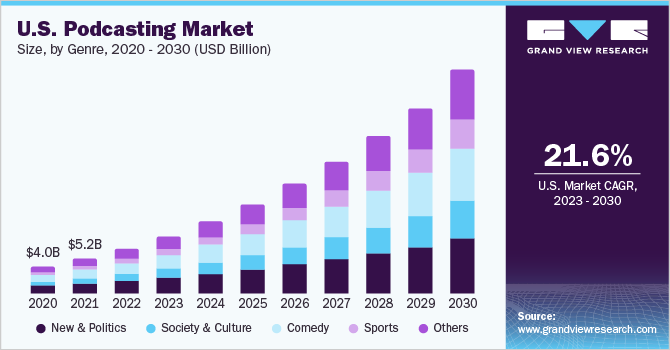
- Statista reported roughly 546.7 million podcast listeners worldwide in 2024. Roughly a third of US listeners now prefer video; 38–48% consume podcasts on YouTube depending on market.
- Most shows that look like overnight successes have been publishing for two or three years before they got noticed. Promotion plans should run for at least 12 months before "this isn't working" decisions get made.
- The shows that grow are the ones that match content people want with consistent promotion that helps people find it. PR is one of the biggest credibility multipliers podcasts have access to.
Table of contents
- What is podcast marketing?
- How podcast marketing differs from traditional marketing
- The three components of a podcast marketing strategy
- The seven podcast marketing tactics that move the needle
- How to choose a podcast marketing agency
- How PR specifically helps podcast growth
- Common mistakes that limit podcast growth
- Frequently asked questions
What is podcast marketing?
Podcast marketing is the set of strategies used to attract listeners, retain them, and turn them into a community around a show. It includes audience research, content positioning, directory submissions, SEO for podcast pages and transcripts, social media distribution, email marketing, paid promotion, cross-podcast collaboration, and earned media coverage.
Podcast marketing is the practice of growing a show's audience through directory optimisation, social distribution, SEO, cross-promotion with other podcasters, and earned media coverage. The job is not to make every channel work — it is to pick the three or four that fit your show, run them consistently, and adjust based on what the numbers say.
The category matters because the audience is real and growing. Statista reported roughly 546.7 million podcast listeners worldwide in 2024. The competition is real too — directories list millions of shows, and most of the audience listens to a small fraction of them. The shows that grow are the ones that match content people want with consistent promotion that helps people find it.
How podcast marketing differs from traditional marketing
| Dimension | Traditional marketing | Podcast marketing |
|---|---|---|
| Primary goal | Conversion or click | Subscribe, then long-term listen retention |
| Audience relationship | Transactional | Parasocial, intimate — listeners spend hours with the host |
| Distribution | Paid channels and SEO | Directories, RSS, social, search, cross-promotion |
| Content cycle | Campaign-based | Episodic — every week or two for years |
| Success metric | ROAS, conversion rate | Downloads, completion rate, follower count, retention |
| Audience growth pattern | Linear with budget | Compounding through word-of-mouth and consistency |
Primary goal
Audience relationship
Distribution
Content cycle
Success metric
Growth pattern
The podcast format rewards patience. Most shows that look like overnight successes have been publishing for two or three years before they got noticed. The marketing job is keeping the show alive and visible long enough for that compounding to start.
The three components of a podcast marketing strategy
1. Identify the right audience
Most failed podcasts target everyone. Successful ones target someone specific. Three things to define before recording episode one:
- Who are they? Industry, role, age band, life stage. Be specific. "Marketers" is too broad; "in-house growth marketers at Series A-to-B B2B SaaS companies" is workable.
- What other shows do they listen to? This determines who you should pitch for cross-promotion and where you should run paid trailer drops.
- Where do they spend time outside podcasts? LinkedIn, X, Substack, Reddit, Discord — that is where you reach them with social distribution.
2. Create content people actually finish
Podcast marketing cannot fix a podcast people do not want to listen to. The fundamentals:
- One clear angle for the show, repeatable across hundreds of episodes
- Predictable release cadence — weekly is the standard, biweekly works if quality is high
- Production quality high enough that listeners do not notice — bad audio kills retention before the topic does
- Episode structure with strong hooks in the first 90 seconds
Completion rate is the metric podcast platforms now reward in their recommendation algorithms. A show that 40% of listeners finish gets surfaced more than a show that 20% finish, regardless of total downloads.
3. Promote consistently across the right channels
Promotion is where most shows give up too early. The promotion plan should run for at least 12 months before any "this isn't working" decisions get made. The seven tactics in the next section cover what should be in that plan.
The seven podcast marketing tactics that move the needle
Submit to every major directory
| Directory | Why it matters |
|---|---|
| Apple Podcasts | Still the dominant iOS directory and a major discovery channel |
| Spotify | Largest podcast platform globally, with strong recommendation algorithms |
| YouTube | Where 38–48% of listeners now consume podcasts depending on market |
| Amazon Music | Growing share of listening, especially among Echo households |
| Pocket Casts, Overcast | Smaller but enthusiast-heavy audiences |
| iHeartRadio, Stitcher | Older user bases, valuable for some categories |
Apple Podcasts
Spotify
YouTube
Amazon Music
Pocket Casts, Overcast
iHeartRadio, Stitcher
Optimise titles, descriptions, and episode notes with the keywords your audience actually searches. Generic titles ("Episode 47: A Conversation") earn no search traffic. Specific ones ("How to Pitch Tier-1 Press as a Founder, with [Guest]") do.
Use social media as the trailer reel
Social distribution is where most discovery happens now. The pattern that works:
- YouTube — Full episode uploads, with custom thumbnails. YouTube has become a primary podcast platform; treating it as an afterthought is the most common growth mistake.
- TikTok and Instagram Reels — 30 to 60-second clips of the strongest moments. These drive trial; full episodes drive retention.
- LinkedIn — One post per episode with a key takeaway, written for the platform's professional tone. Consistently outperforms its reputation for podcast distribution.
- X (Twitter) — Episode quote tweets, guest tags, conversation participation. Less linear growth, but high-leverage when it works.
Roughly 33% of US podcast listeners now prefer video formats. Audio-only distribution leaves a meaningful share of the audience unreachable.
Cross-promote with other podcasters
The single highest-ROI growth tactic for most shows. Three patterns:
- Guest swaps. You appear on their show, they appear on yours. Each podcast's listeners get exposed to the other's host.
- Trailer swaps. Run their trailer in your feed, they run yours. Common in podcast networks, valuable even outside them.
- Co-hosted episodes. One-off episodes recorded together and released on both feeds.
Cross-promotion works because the audience already trusts the host doing the recommending. A 30-second trailer endorsed by a host you trust converts better than any paid acquisition channel.
Optimise for search
Podcast SEO has two layers — the directories themselves (Apple, Spotify, YouTube search) and Google. The fundamentals:
- Keyword-rich episode titles that match how listeners search
- Detailed show notes with timestamps
- Full transcripts published on a dedicated website (this is the SEO gold for Google)
- Schema markup for episode pages
Transcripts especially matter in 2026 because AI search engines like ChatGPT and Perplexity now cite podcast transcripts when they answer questions. A show without transcripts is invisible to that growing audience.
Build a dedicated website
A real website with episode pages, show notes, transcripts, host bios, and an email list is not optional. It is where your show owns its audience instead of renting from a platform. Five things every podcast website should have:
- Embedded player on each episode page so visitors can listen without leaving
- Full transcripts indexed by Google
- Email signup with a clear value proposition
- Links to every directory the show is listed on
- Contact information for guest pitches and press
Repurpose every episode
One episode produces a dozen pieces of content if you handle it right:
- Long-form blog post drawn from the transcript
- Email newsletter with key takeaways
- 3–5 short video clips for TikTok, Reels, and YouTube Shorts
- Audiograms with quote text for static social posts
- LinkedIn carousel summarising the main points
- Quote graphics for X and Instagram
The best podcast marketing teams treat each episode as the source for a full week of content distribution.
Use PR to build authority
Earned coverage in respected publications builds the credibility that no amount of social posting can. Three concrete moves:
- Pitch your host as a source on industry topics relevant to journalists
- Get the show featured in roundups (Forbes, Entrepreneur, Inc., trade publications)
- Submit for "best of" lists and podcast awards in your category
Princeton's GEO research (KDD 2024) found that adding citations from credible sources lifts AI visibility by up to 40%. For podcasts, that translates: shows whose hosts get quoted in major outlets are far more likely to be recommended when listeners ask AI engines for podcast recommendations in their niche.
For the broader approach, see our podcast placement service or read how to get featured in top publications.
Get your host into the publications listeners already read.
Forbes, Business Insider, Entrepreneur, and 700+ publications. From $990 per story. Money-back guarantee. Most placements published within 72 hours.
See pricing →How to choose a podcast marketing agency
| What to evaluate | What strong looks like |
|---|---|
| Genre experience | Demonstrated growth for podcasts in your category, not just generic case studies |
| Strategy fit | Custom plans for your show, not packages applied to every client |
| PR capability | Active relationships with media that cover your space |
| Reporting | Listener growth, retention, completion rate, ranking — not just downloads |
| Cross-promotion network | Existing relationships with other podcasts in your category |
| Pricing transparency | Clear deliverables tied to clear costs |
Genre experience
Strategy fit
PR capability
Reporting
Cross-promotion network
Pricing transparency
Five questions worth asking before signing:
- Does the agency have experience in your podcast's genre?
- Can they provide three references from current or recent clients?
- What does their growth look like for shows at your stage?
- Which metrics will they track, and how often will they report?
- What happens in months 4–6 if growth is slower than expected?
How PR specifically helps podcast growth
Three concrete benefits PR brings to podcast marketing that generic agencies often skip:
- Credibility transfer. A feature in a respected publication tells potential listeners the show is worth their time. This shortcuts trust that takes months to build through content alone.
- Discovery beyond podcast platforms. Podcast directories are saturated. PR places the show in front of audiences who do not browse directories — they read industry publications.
- Host positioning. Earned coverage positions the host as an industry voice, which makes the podcast itself more valuable to listeners and more attractive to advertisers and guests.
PR works best when paired with the consistent organic effort outlined above. A single Forbes feature without ongoing distribution generates a spike. The same feature combined with consistent social, SEO, and cross-promotion compounds.
Common mistakes that limit podcast growth
- Quitting too early. Most shows need 12–24 months of consistent publishing before they hit growth inflection.
- Skipping the website and transcripts. Without them, the show is invisible to Google and AI search.
- Generic episode titles. "Episode 23: Marketing" earns no search traffic. Specific titles do.
- Audio-only distribution. Roughly a third of listeners now prefer video. Skipping YouTube cedes that share.
- Ignoring cross-promotion. The single highest-ROI growth tactic for most shows.
- Treating PR as optional. Earned coverage is one of the biggest credibility multipliers podcasts have access to.
- Inconsistent release cadence. Algorithms and listeners both penalise unpredictable shows.
Frequently asked questions
Most shows that reach meaningful audiences took 12–36 months of consistent publishing to get there. The first six months are usually slow regardless of marketing budget. The compound growth typically starts around month 12–18, when SEO traffic, cross-promotion relationships, and word-of-mouth all start working together. Programs cut at month three consistently understate what podcast marketing is delivering.
DIY founder-led marketing costs time, not money. Agency-supported programs typically run $3K–$15K per month depending on scope, channels, and PR component. The right benchmark is not dollar amount — it is whether the program is generating measurable lift in downloads, completion rate, and audience growth.
Podcast marketing covers everything that drives audience — directories, social, SEO, cross-promotion, paid acquisition. Podcast PR is the subset focused on earning media coverage and authority signals. The strongest programs do both. PR-only without distribution leaves audience growth on the table; distribution-only without PR leaves credibility unbuilt.
Yes. Roughly a third of US podcast listeners now prefer video, and YouTube has become a primary discovery platform. At minimum, post short clips. For most shows, full video episodes on YouTube are worth the production cost.
Important on Apple Podcasts, where they directly affect ranking and visibility. Less critical on Spotify and YouTube, where the algorithms weight completion and engagement more heavily. Encourage reviews actively — most listeners will not leave one unless asked.
Increasingly significantly. When listeners ask ChatGPT, Perplexity, or Google AI Overviews for "best podcast about [topic]," the answer comes from earned media coverage and indexed content (transcripts, show notes, articles citing the host). Shows without transcripts and PR coverage are invisible to that growing search behaviour.
Where to go next
If you are growing a podcast, the foundation is the same regardless of size: clear audience, consistent content, distribution across the right channels, and earned coverage that builds authority over time. Browse our podcast placement service, see pricing for guaranteed media coverage, or read how stories become coverage that builds credibility.
The podcasts that grow are not the ones with the most expensive equipment or the biggest launch announcements. They are the ones that kept publishing, kept distributing, and kept building authority — long enough that the compounding finally caught up with the work.
Read More BadenBower's Articles
Get Your Business Featured in Major Publications
We reply within 1 business day. Your information is never shared or sold.